

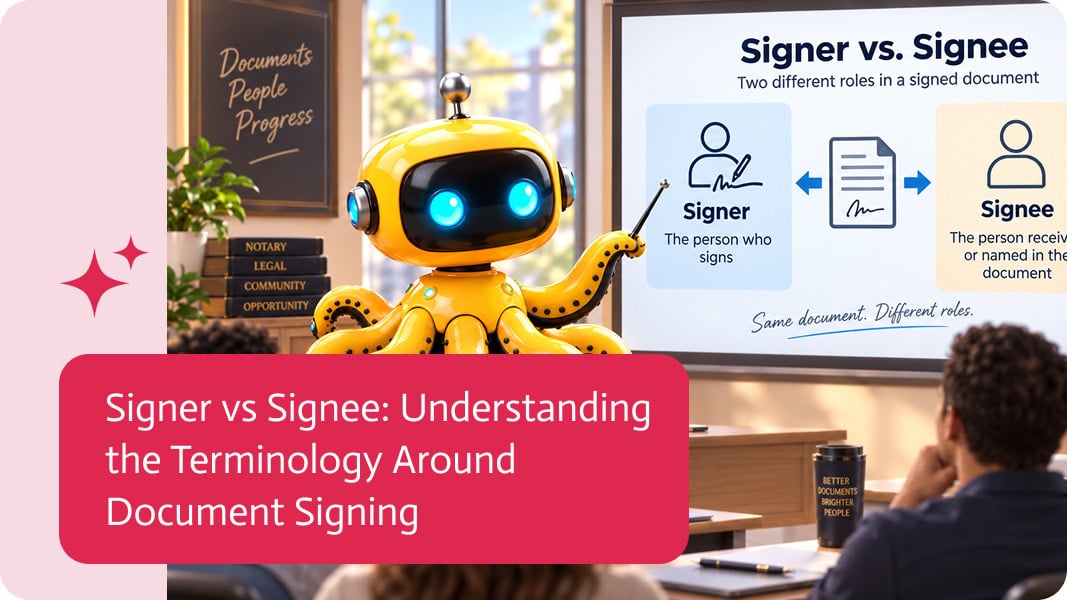
Signer vs Signee: Understanding the Terminology Around Document Signing
When working with contracts, agreements, approvals, and other business documents, there is a specific terminology used to describe the people and organizations involved in the signing process.
Terms such as signer, signee, and signatory are often used interchangeably, but they describe different roles.
Understanding the difference between signer vs signee helps make document workflows clearer, especially when multiple people or organizations are involved. Knowing the difference makes it easier to understand who is signing the document, who the document relates to, and what role each person or organization has.
Common Signing Terms
Signer
A signer is the person who actually provides the signature on a document.
The term focuses on the action of signing.
A signer could be:
- An employee signing an agreement
- A manager approving a document
- A customer signing a contract
- An authorized representative signing on behalf of a company
Signee
A signee is generally the person or party receiving a document and expected to agree to it by signing. In many cases, the signee is also the signer, so the two terms can refer to the same person. The main difference is that signer focuses on the person who actually signs, while signee describes the person who is expected to sign the document.
Signatory
A signatory is a person or organization that formally becomes a party to an agreement through a signature. This term is often used in more formal legal or corporate contexts.
A company, for example, may be the signatory to a contract even though an authorized employee physically signs the document on its behalf.
Signer vs Signee: What Is the Difference?
The simplest way to understand signer vs signee is:
Signer refers to the person who performs the signature.
Signee refers to the person or party expected to receive, review, and agree to the document.
In many everyday workflows, one person performs both roles.
The terminology becomes more important when a document involves several parties, representatives, approval stages, or delegated authority.
Why Signing Terminology Matters in Automated Workflows
When documents are handled manually, people often understand from context who needs to sign and what happens next.
In an automated document workflow, these roles need to be defined more clearly.
The system may need to know:
- Who receives the document
- Who is authorized to sign it
- Whether several signatures are required
- Which organization each signer represents
- What should happen after each signature
- Which business record should be updated
Clear terminology helps avoid routing a document to the wrong person or assigning the wrong role in the process.
Signer vs Signee in Noca AI
Noca AI can connect document generation and signing steps with broader business workflows.
Signer and signee information can come from connected CRM, ERP, HR, or other business systems, allowing the correct document to be generated and routed to the appropriate people.
A workflow can then continue based on what happens during the signing process, for example by updating a business record, notifying another person, or starting the next stage automatically.
This turns document signing from an isolated action into part of a connected business process.
Example: Supplier Agreement
Consider a company onboarding a new supplier.
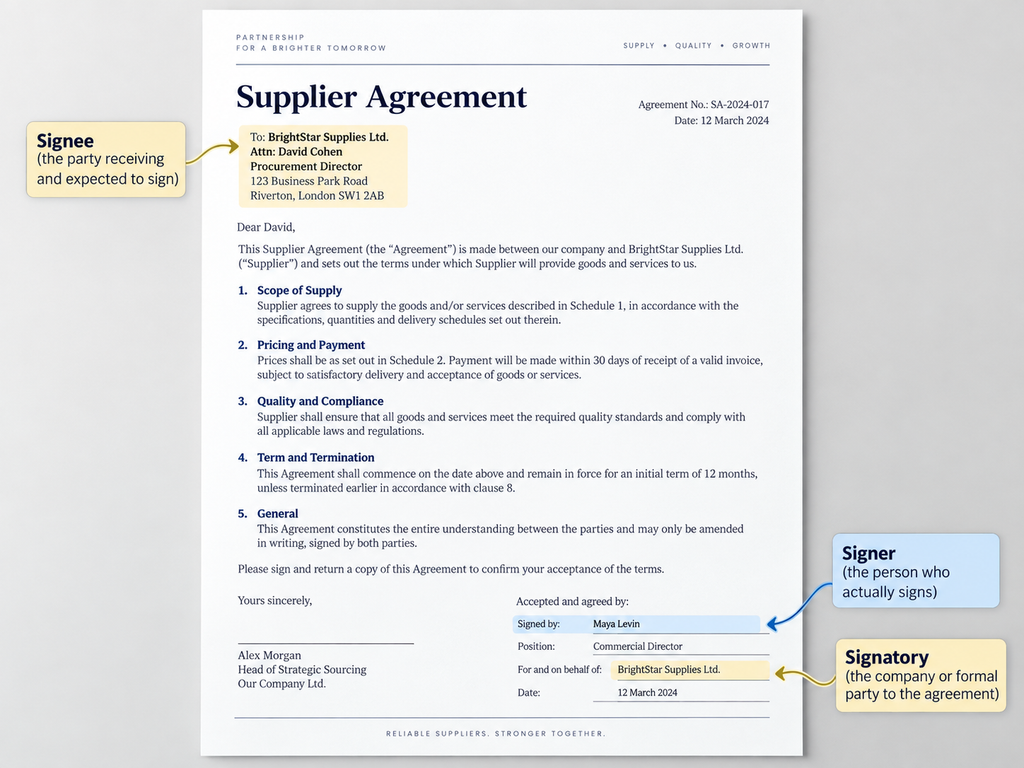
The supplier company is one of the parties to the agreement and may therefore be considered a signatory.
The supplier’s authorized representative receives the agreement and is the signee expected to review and accept it.
When that representative signs the document, they become the signer.
On the other side, a procurement manager or legal representative may sign on behalf of the company as another signer.
With Noca AI, supplier information can be pulled from the relevant business system, the agreement can be generated from a template, routed to the correct representatives, and the supplier record can be updated automatically once the process is complete.
Frequently Asked Questions
Can a signer and signee be the same person?
Yes. This is very common. A person can receive a document as the signee and then become the signer when they provide their signature.
Is a signatory always a person?
No. A signatory can also be a company, organization, or other legal entity that becomes a party to an agreement.
Can someone sign on behalf of another organization?
Yes, if they have the proper authority to do so. In this case, the individual is the signer, while the organization may be the signatory.
Why does the terminology matter?
The difference is useful when designing contracts and automated workflows because it clarifies who receives the document, who actually signs it, and which party is legally associated with the agreement.
Summary
There is a useful terminology around document signing, and understanding it helps make agreements and workflows easier to manage.
When comparing signer vs signee, the signer is the person who provides the signature, while the signee is the person or party expected to receive and agree to the document.
A signatory is the person or organization formally entering into the agreement.
Defining these roles clearly becomes especially important when document processes are automated and connected to other business systems.

Opportunity stages in Salesforce are supposed to tell you where a deal stands, but stages don’t do anything on their own. A brand-new opportunity can…

The User object in Salesforce represents individuals who have access to the Salesforce platform. It contains key details about each user, including login credentials, roles,…

Remember when coding meant late nights glued to your screen for hours, filled with weird symbols? Get ready for a change because artificial intelligence is…