
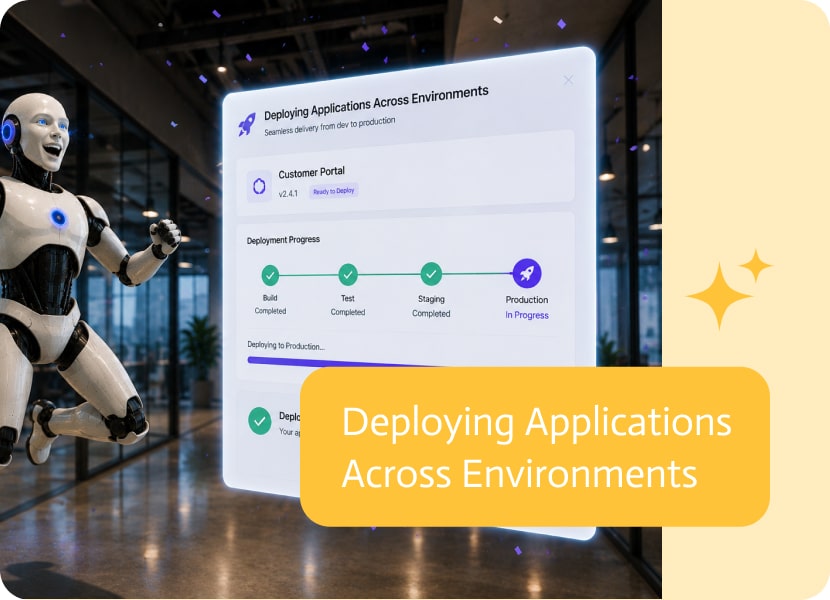

Deploying Applications Across Environments
Moving an application from development to testing or production is more than copying the app itself. Behind every application are automations, integrations, and environment-specific connections that also need to be configured correctly.
A structured deployment process helps ensure everything continues to work after the application is moved.
Applications Depend on More Than Pages
Modern business applications rarely stand alone.
An app may include multiple flows, connect to external systems, and rely on integrations that are different in each environment. For example, your development environment might connect to a sandbox CRM, while production uses live business systems.
Moving the application means moving all of these relationships as well.
Handle Connections During Deployment
One of the biggest challenges when deploying applications is reconnecting them to the correct systems.
Rather than recreating integrations manually after deployment, a connection mapping process allows builders to select the appropriate connections in the destination environment, ensuring the application continues to work without modifying its logic.
Simplify Production Releases
Deploying to production should be predictable and repeatable.
Packaging the application together with its related resources creates a smoother deployment process and reduces the risk of missing dependencies or connecting to the wrong environment.
Scale with Confidence
As organizations build more applications, moving solutions between environments becomes part of everyday development.
A structured import and export process with connection mapping makes deployments more reliable, reduces manual configuration, and helps teams move applications from development to production with confidence.
Hi Guys, this version is about making apps feel more complete, more flexible, and more useful in real business scenarios. We added stronger building blocks…
The conversation around automation has shifted dramatically. In 2025 already, we’re no longer talking about simple AI chat bot or rule-based scripts. The new frontier…
Why Surveys Are More Expensive Than They Look For a lot of businesses, surveys are doing real work. Lead qualification, NPS, customer health, event registration,…