
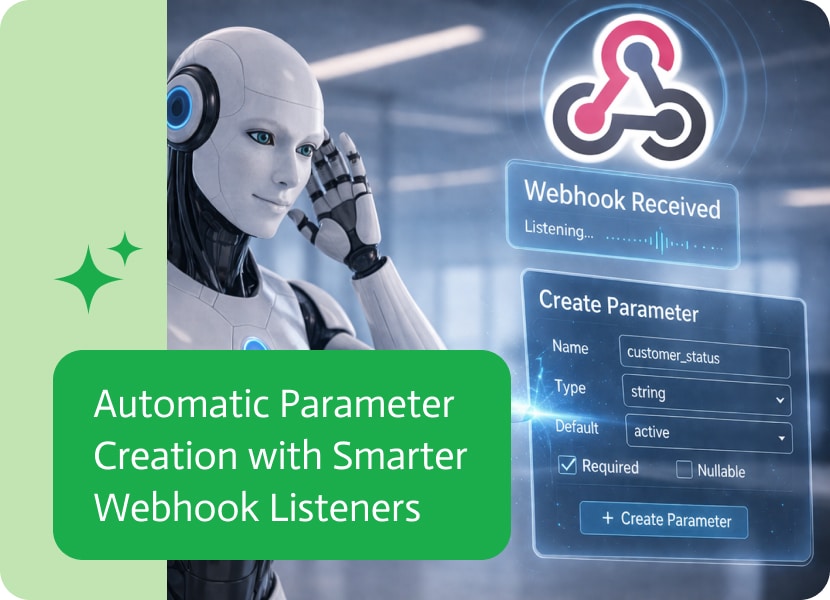

Automatic Parameter Creation with Smarter Webhook Listeners
Automation works best when systems can react instantly. Instead of waiting for updates or relying on manual steps, modern workflows are increasingly built around real-time communication. One of the key building blocks behind this shift is the webhook listener.
In this article, we’ll explore how webhook listeners make automation smarter, and how automatically capturing returned data as parameters can simplify workflows and reduce manual effort.
What Is a Webhook Listener?
A webhook listener is like a digital “receiver” that waits for information to arrive from another system. When something happens—like a form submission, a payment, or a status update—data is sent instantly to this listener.
Instead of constantly checking for updates, the listener simply reacts when something occurs. This event-driven approach allows systems to respond immediately, without delays or unnecessary processing.
Think of it like a doorbell: instead of checking every few minutes to see if someone is at the door, you get notified the moment they arrive.
From Receiving Data to Acting on It
When a webhook listener receives data, it typically triggers a workflow. This might include:
- Creating or updating records
- Sending notifications
- Triggering follow-up actions
- Passing data to other systems
Because the data arrives in real time, workflows can start immediately, improving speed and responsiveness across processes.
This is especially useful for repetitive tasks that would otherwise require manual handling, helping teams stay efficient and consistent.
The Challenge: Handling Incoming Data
While receiving data is powerful, it can also introduce complexity. Incoming webhook data often contains multiple fields and values that need to be mapped and organized before they can be used effectively.
Traditionally, this means:
- Manually selecting which data to use
- Mapping fields between systems
- Repeating the same setup for each workflow
As workflows grow, this manual effort can become time-consuming and prone to errors.
Automatic Parameter Creation: A Simpler Approach
To make things easier, webhook listeners can automatically capture incoming data and turn it into usable parameters.
In simple terms, this means:
- Data is received →
- Relevant values are identified →
- Parameters are created automatically
Instead of manually defining each field, the system does it for you.
This approach removes much of the setup work and allows workflows to adapt quickly to incoming data without extra configuration.
Why This Matters for Automation
Automatically creating parameters from webhook data brings several key benefits:
- Faster Setup
Workflows can be built more quickly since there’s no need to manually map every field. - Reduced Errors
Automation reduces the risk of missing or incorrectly mapped data.
- Greater Flexibility
As incoming data changes, workflows can adapt without requiring constant updates.
- Cleaner Workflow Design
By handling data capture automatically, workflows become easier to read, manage, and maintain.
Real-World Impact
In practice, this means teams can focus less on configuration and more on outcomes.
For example:
- A new event occurs → data is sent instantly
- The listener captures everything automatically
- Parameters are created without manual input
- The workflow continues smoothly
This kind of seamless data handling keeps processes reliable and scalable as activity grows.
Moving Toward Smarter Automation
Webhook listeners already enable real-time automation by reacting instantly to events. Adding automatic parameter creation takes this a step further by simplifying how incoming data is handled.
The result is a more streamlined automation experience—one where workflows are easier to build, faster to run, and simpler to maintain.
As automation continues to evolve, reducing manual steps like data mapping will play a key role in making systems more accessible and efficient for everyone.

So you’re on a Zoom call, pitching the idea of your life, and just as you’re hitting your stride, bam! your dog decides it’s karaoke…

Most opportunity management in Salesforce is really about one question: what happens the moment a deal becomes real. “Closed Won” is not just a stage…
AI chatbots sure have evolved since the clunky, one-size-fits-all pop-ups we saw a decade ago. By 2025 they’re doing much more than answering FAQs: they’re…