
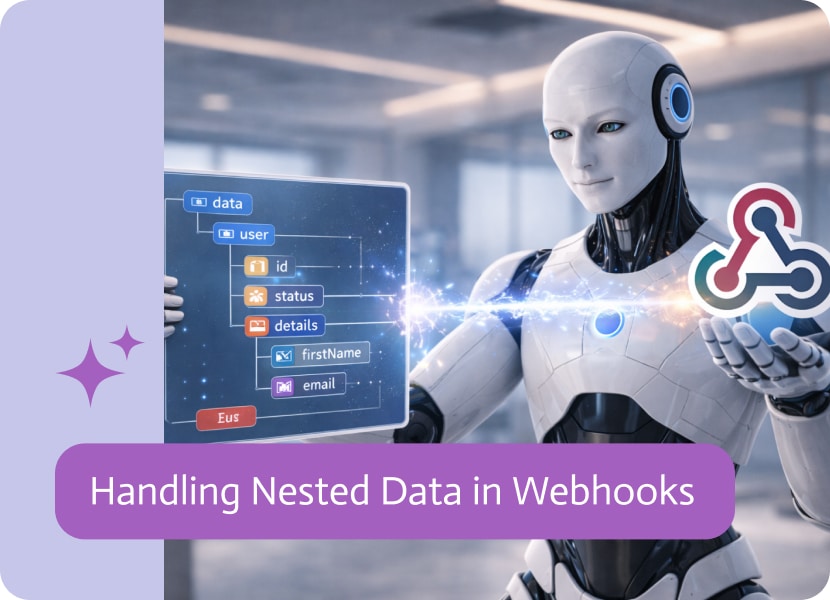

Handling Nested Data in Webhooks
If you’ve ever worked with integrations, you’ve probably run into this: the data you get isn’t nice and flat. It comes layered, grouped, and nested in ways that feel more like a maze than a message.
And honestly, that’s not a bug, it’s just how real-world data works.
Not All Data Is Simple (And That’s Fine)
In theory, it would be great if every system sent clean, single-level data. A neat list of fields, easy to read, easy to use.
In reality, things look more like this:
- A list of orders, each with multiple items
- A user, with multiple addresses and preferences
- A project, with tasks, each with their own updates
This kind of structure, often called “nested data,” is everywhere. It reflects how information actually behaves in the real world, grouped, connected, and layered.
The Problem with Flattening Everything
For a long time, working with this kind of data meant simplifying it. Breaking it apart. Flattening it.
That might sound convenient, but it comes at a cost:
- You lose context between related items
- You end up duplicating data just to make it usable
- Things get messy fast when the structure grows
What started as “simplifying” quickly turns into more work and more edge cases to handle.
Letting Data Stay as It Is
A better approach is to work with data in its natural shape.
Instead of forcing everything into a flat structure, you keep the hierarchy intact:
- Lists stay lists
- Items stay grouped
- Relationships remain clear
This means you can pass richer payloads between systems without stripping away meaning or structure.
Why This Matters for Integrations
Modern systems don’t just send single values, they send collections, variations, and nested details. Think:
- Multiple results in one response
- Structured content like documents or records
- Hierarchies that reflect real workflows
Being able to handle all of that smoothly means:
- Fewer transformations
- Less manual cleanup
- More reliable data handling overall
In other words, things just flow better.
Less Work, Fewer Surprises
When you can pass and process nested data as-is, you avoid a lot of unnecessary complexity.
You don’t have to:
- Rebuild structures later
- Guess how pieces connect
- Patch things together after the fact
Everything arrives the way it was meant to, and stays that way.
The Bigger Picture
This isn’t just about handling arrays or sub-items. It’s about moving toward a more natural way of working with data.
One where systems don’t force you to simplify reality just to make things function.
Because the truth is, data is complex. And the closer you stay to that reality, the easier everything becomes.
The Deal: The Heart of the Sales Pipeline Today’s sales success holds itself on efficient management of opportunities, and HubSpot CRM Deals API brings the…
Snowflake data integration is really about connecting the Snowflake platform with almost any source you can imagine, from websites, apps, and sensors to legacy databases….

Communication channels are a core part of many digital processes, especially when handling customer interactions, support requests, or messaging across multiple platforms. As workflows become…