
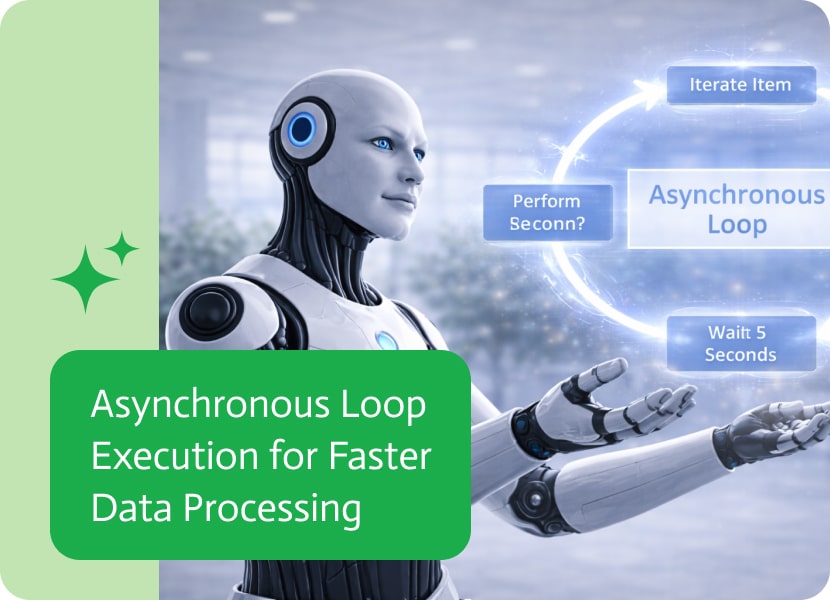

Asynchronous Loop Execution for Faster Data Processing
When working with large datasets in automated workflows, loops are often used to process records one by one. However, as data volume grows, sequential processing can become slow and inefficient.
To address this, loop execution can now run asynchronously, allowing multiple iterations to be processed in parallel.
From Sequential Processing to Parallel Execution
Previously, when working with large datasets—such as hundreds of records from systems like Salesforce—each item in a loop was processed step by step.
For example, if each record required multiple actions (such as creating an account and then creating a related contact), the workflow would complete all steps for one record before moving on to the next. While reliable, this approach could take significant time when processing large volumes of data.
Processing in Parallel Batches
With asynchronous loop execution, the workload is now divided into batches.
Instead of handling everything sequentially, the system processes multiple iterations at the same time within controlled limits. For example, a batch may include up to 20 iterations, each supporting multiple actions.
Each batch runs in parallel, and once it completes, the next batch begins processing.
This structure significantly improves efficiency while still maintaining control over execution.
Why This Matters
This approach brings major improvements when working with large-scale data:
- Faster processing through parallel execution
- Reduced total execution time for large datasets
- Better scalability for complex workflows
- Controlled batching to maintain system stability
In many cases, performance improvements can be significant—depending on configuration, execution can be up to dramatically faster compared to sequential processing.
A More Scalable Way to Process Data
By combining batching with asynchronous execution, workflows can now handle large datasets much more efficiently. Instead of waiting for each item to complete one after another, multiple items are processed in parallel within structured limits—making large-scale automation faster, more predictable, and easier to scale.

Building or changing an application with AI is often not instant. You describe what you want, the AI processes the request, updates the application, and…

You have a plan. In this vision, your customers are talking on the phone with a helpful, sophisticated voice. This voice doesn’t sleep, ask for…
A Salesforce Task object is a record that represents an action assigned to a user, such as a follow-up call, email, or any other scheduled…