
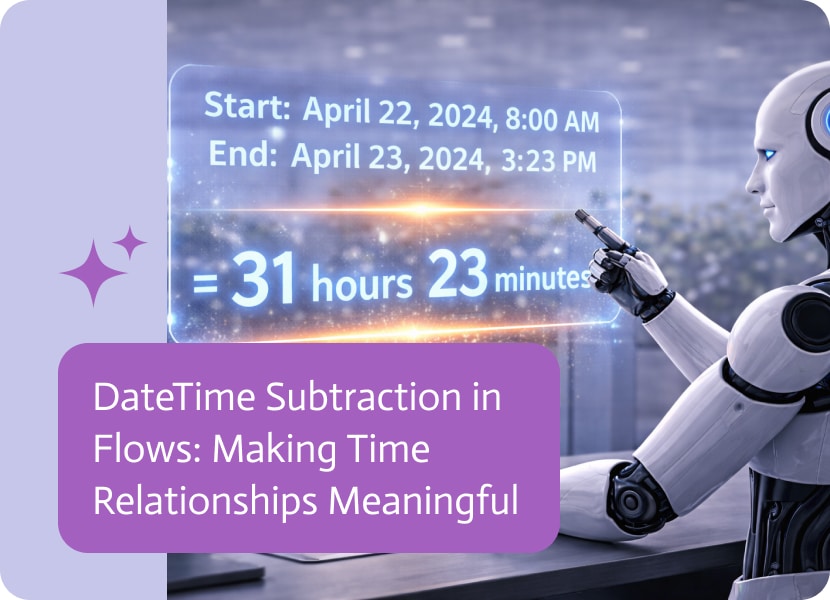

DateTime Subtraction in Flows: Making Time Relationships Meaningful
In flows, data is rarely static.
It moves from one step to another, triggering actions, passing information, and reacting to events. And very often, that data includes time – when something started, when something ended, or when something changed.
But while timestamps are easy to capture, the relationship between them is where things become interesting.
When Flows Need to Understand Time, Not Just Store It
A flow might know when something happened, but not always what that timing means.
And in many cases, what really matters is the difference between two moments:
- How long did a process take between steps?
- How much time passed before an action was triggered?
- What is the duration between two events in the flow?
These are the kinds of questions that require time to be compared, not just recorded.
Why Time Differences Matter in Flow Logic
As flows become more dynamic, timing becomes part of the logic itself.
It’s no longer just about what happens next, but how long it took to get here.
Without a way to compare DateTime values, flows often need additional steps or external handling just to calculate something as simple as a duration.
Subtracting DateTimes Inside Flow Logic
DateTime subtraction introduces a direct way to compare two moments in time within the flow itself.
By subtracting one DateTime value from another, flows can immediately determine:
- The time elapsed between steps
- The duration of a process
- The gap between events
The result becomes a usable value that can influence decisions, conditions, or further actions in the flow.
Turning Timing Into Part of the Logic
Instead of treating time as background information, it becomes part of the flow’s decision-making.
A flow can now understand not just that something happened, but how long it took—and respond accordingly.
This makes time-aware logic more natural, more direct, and easier to work with inside the flow itself.
Making Flows More Time-Aware
Time is often the hidden layer in automation—it quietly shapes how systems behave.
With DateTime subtraction, that layer becomes visible and usable, allowing flows to work not just with events, but with the relationships between them.
The ‘Product’ object in Salesforce represents the products or services that a company is selling. Also sometimes called Product2, this object serves as the foundation for product catalogs, pricing, and…

In today’s fast-paced, remote-first work environment, the integration of Salesforce, a leading CRM platform, with Microsoft Teams, a widely used communication and collaboration tool, offers…

Chat conversations can reveal a lot about what users need, what confuses them, and what they are trying to accomplish. But when those conversations are…