
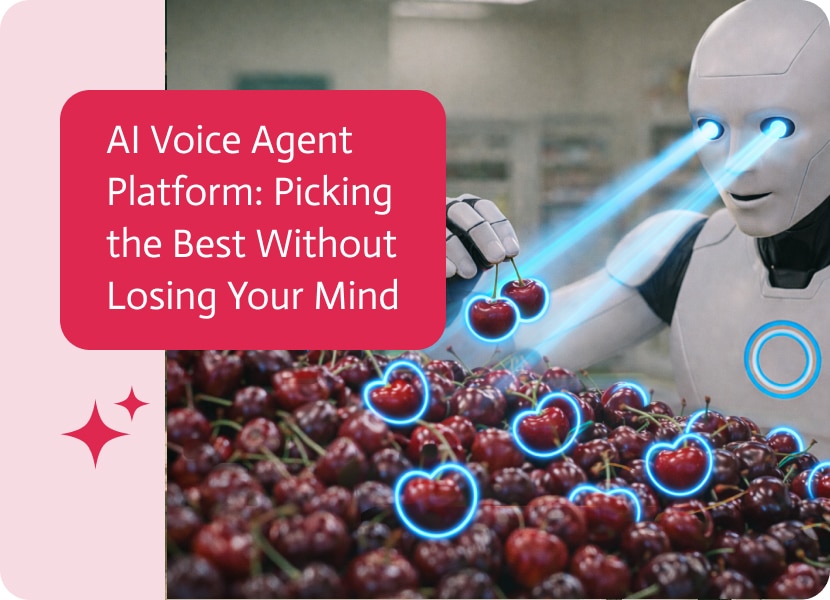

AI Voice Agent Platform: Picking the Best Without Losing Your Mind
You have a plan. In this vision, your customers are talking on the phone with a helpful, sophisticated voice. This voice doesn’t sleep, ask for a raise, or take a “mental health day” in the middle of Q4. You want a voice bot, but you realize you don’t know the first thing about coding. You don’t know the distinction separating Python from a snake, and your knowledge of “Java” stops at your morning coffee, that’s exactly where an AI voice agent platform comes into play.
Think of these platforms that help grow your AI workers. If the soil is bad, your agent will be a sick, hallucinating mess that gives customers 90% off everything you have because it got confused. You can get a strong, enterprise-grade agent able to manage endless calls without breaking a sweat if the soil is rich and fertile.
AI voice agent platforms should work as easily as Legos. You don’t need to know how to make the plastic bricks; you just need to know what you want to build. Are you in need of just a simple FAQ bot or a fully integrated, multi-modal enterprise system (like the Death Star)? Your platform choice will decide if you get a work of art or a pile of plastic on the floor that hurts when you step on it.
This article is your guide. Let’s get rid of the marketing fluff and look at the infrastructure’s rusty bolts.
No-Code vs. Pro-Code: How to Choose Your AI voice agent platform
Let’s talk about the big issue in the server room: technical ability. The first thing you need to know when looking for the best AI voice agent platform is the difference between “no-code” and “pro-code” (also known as “low-code”) solutions. This isn’t just a list of features; it’s a philosophical choice about how much control you want and how much therapy you can afford.
The No-Code AI voice agent platform
No-code platforms are for people who dream, market, and run businesses but don’t know how to make a computer say what they want it to say. They employ flow builders, which are drag-and-drop interfaces that look like flowcharts you’d draw on a whiteboard. With that being said, it’s important to know that there are a few that don’t operate in this way, which you’ll see soon enough.
- The pros are speed and sanity. You can make a prototype in just one afternoon. You pull a “Listen” block, link it to a “Process” block, and finish with a “Speak” block. It makes sense. It seems like magic.
- The bad thing is that you are playing in a walled garden. If the platform doesn’t have a specific block for a feature you need, like a specific type of encryption or a niche API call, you’re usually out of luck. You are giving up unlimited flexibility in exchange for being able to use it right away.
The Pro-Code Powerhouse
On the other hand, there are pro-code services for developers who don’t like drag-and-drop interfaces because they feel like they’re being talked down to. They give you the basic developer kits and software interfaces so you can write the logic the way you want.
- The Good: Control like a god. You can tell the agent to do literally anything the LLM used can do. Logic loops that are hard to understand? Personalized protocols? Can you connect to a database from 1998 that is still running on a server in a basement? Pro-code can do it.
- The bad: You’ll need a dev team. And not just any dev team, but one that knows how to handle APIs, manage latency, and design conversations. If your script crashes, the agent breaks too, and there is no way for a customer who just got hung up to go back.
The Decision
A “low-code” AI voice agent platform is usually the sweet spot for most business leaders. These let you build 90% of the standard conversation flows visually, but you can also add your own code (usually JavaScript or Python) for the 10% of logic that is more complicated and specific to your business. You get the LEGOs, but you can also 3D print your own pieces when you need to. It’s the best of both worlds.
AI voice agent platform Integration Station
Integrations are like the nervous system for the platform. If an AI agent can’t talk to your other software, it’s not an agent; it’s just a chatty problem.
The “integration station” is the most common place where an AI voice agent platform fails. This is where your shiny new AI tries to shake hands with your old, worn-out Customer Relationship Management (CRM) system.
The “Read” vs. “Write” Trap
A lot of platforms say they have “seamless integration,” which usually means they can read data. The agent can find out who the customer is and say, “Hi, Dave.” That’s sweet. But can it write data?
Think about this situation: A customer calls to change the address on their bill.
- The Bad Agent: “Okay, I’ve changed that for you!” (It hasn’t. It just made up a confirmation because it can’t write to your database. Dave will call back in a month, and he’ll be very angry.
- The Good Agent: It sends a webhook, logs in to your CRM, sends the new address, waits for a “Success” code from the database, and then tells Dave it’s done.
Latency: The Conversation Killer
Integrations are also where latency goes to die. Silence is deadly in a voice conversation. If your user asks, “When will my order arrive?” and the AI Voice Agent Platform takes four seconds to check your ERP system, those four seconds feel like four hours. The person on the other end will think the line is dead and hang up or start yelling “HELLO?” which makes things even more confusing for the AI.
You need a platform that can handle data dips with low latency. This means that the architecture is made to get data faster than a person can blink. It often means storing data that is accessed often or using edge computing to process requests closer to the user.
Old Systems: The Ghosts in the Machine
We all like to talk about modern tech stacks, but in the real world of business, important data is often stored in old systems. Do you know if your chosen platform has built-in connectors for Salesforce and HubSpot? Most likely. Does it have a way to connect to the custom SQL database that your IT guy made in 2009? Most likely not.
To build bridges to those old islands, you need an AI voice agent platform with a strong API layer. This means it can handle REST and SOAP requests (yes, SOAP, unfortunately). If the platform doesn’t care about integrations, get out of there. Your agent can only be as smart as the information it has access to.
The AI voice agent platform “Crash” Test for Scalability
Building a voice agent that can handle one call is simple. Building one that can handle ten is not too hard. But being able to handle 10,000 calls at once during a service outage or product launch? That is a whole other thing.
Scalability is the metric you don’t care about until you desperately, frantically do.
The Problem with Concurrency
Call centers for people grow in a straight line. To handle twice as many calls, you need about twice as many people (and desks, coffee, and HR complaints). An AI voice agent platform should be able to grow and shrink as needed.
But not all platforms are made the same. Some use shared infrastructure that slows down when there is a lot of traffic. Think of your agent as a cashier. When the line gets longer, new cash registers automatically show up to help customers in a scalable system. In a system that can’t be scaled, the cashier just works more slowly, or the store catches fire.
You need to ask vendors how many people can use their services at once. How many conversations can the platform handle at once before it hits its limit? And more importantly, what will happen when you reach that limit? Does the call end? Does it switch to a busy signal? Or does it queue up nicely?
The Latency-Load Curve
There is a dirty secret in AI: when the load goes up, the intelligence often goes down (or at least the speed does). If the AI Voice Agent Platform sends all requests through one central LLM inference engine, a lot of traffic can make the “time-to-first-byte” (how fast the AI starts talking) slower.
A platform that can really grow uses a distributed architecture. It automatically creates new “inference instances” based on how busy it is. It separates the “telephony” layer, which handles the audio connection, from the “intelligence” layer, which makes the text. This makes sure that the audio connection stays stable even when the brain is working hard.
Redundancy Around the World
Your platform needs to be global if your business is too. A server in Virginia is great for people in New York, but for people in Sydney, the speed of light is a problem. Routing audio halfway around the world will add latency, which will make your AI sound drunk and slow.
Regional edge nodes are found on the best AI voice agent platforms. They may only send the text (which is much smaller and faster) to the central brain, or they may copy the brain across different regions. This makes sure that a customer in Tokyo has the same quick experience as a customer in Texas.
Noca AI: Business-Level AI voice Agent Platform
We need to talk about Noca when it comes to platforms that get the job done. Noca has carved out a niche as a heavy-hitter for enterprise infrastructure in a market full of generic “wrapper” bots that are just ChatGPT with a voice synthesizer.
Noca AI isn’t just playing around with conversation; they are obsessed with the “Speech-to-Action” pipeline.
Deep System Connectors
Do you remember the nightmare we talked about with integration? Noca AI fixes this with native connectors that go deeper than the surface. They work well with CRM, ERP, and ticketing systems. We are talking about an agent’s ability to do more than just “take a message.” They can also open a ticket, update a CRM record, check inventory in an ERP, and process a payment, all in real time, without the “silent treatment” delay.
Security First
For businesses, security isn’t just a feature; it’s the law. Noca is compliant with SOC 2, GDPR, and HIPAA. They use end-to-end encryption and access based on roles. This is very important because “trust me, bro” is not a good way to keep patient data or credit card numbers safe when you let an AI do it.
The “Dedicated Pod” Architecture
This is what makes them able to grow. Noca runs requests in separate pods that are not connected to each other. This means that your sales campaign with a lot of traffic won’t crash your support line, and your data won’t mix with another client’s data. It is like giving each agent their own soundproof office in the digital world.
Noca AI fills in the gap we talked about before. It has the ease of deployment that businesses need to be flexible, but it also has the power of vibe coding to handle complex, secure, enterprise workflows.
The AI Voice Agent Platform Selection Conclusion
Picking an AI voice agent platform is like getting married. It costs a lot to get into, is hard to get out of, and you’ll have to talk to each other every day. Don’t get seduced by a flashy demo video of an agent ordering a pizza. You’re not selling pizza, you’re running a business.
The agent is created by the underlying infrastructure. You can write the best script in the world, but if the platform can’t handle the load, the latency, or the logic, you’re just making things worse. Pick a platform that helps your brain grow without hurting it.
In today’s business world, efficiency drives success. Companies of all sizes depend on smooth workflows to manage customer relationships, internal operations, and communications. One of…

These computer programs make use of AI and its subdivisions, particularly machine learning, to transform an audio stream into written output. They make use of…
HubSpot changed the way businesses work by promoting “inbound,” which means that you should attract customers by giving them value instead of bothering them. But…