

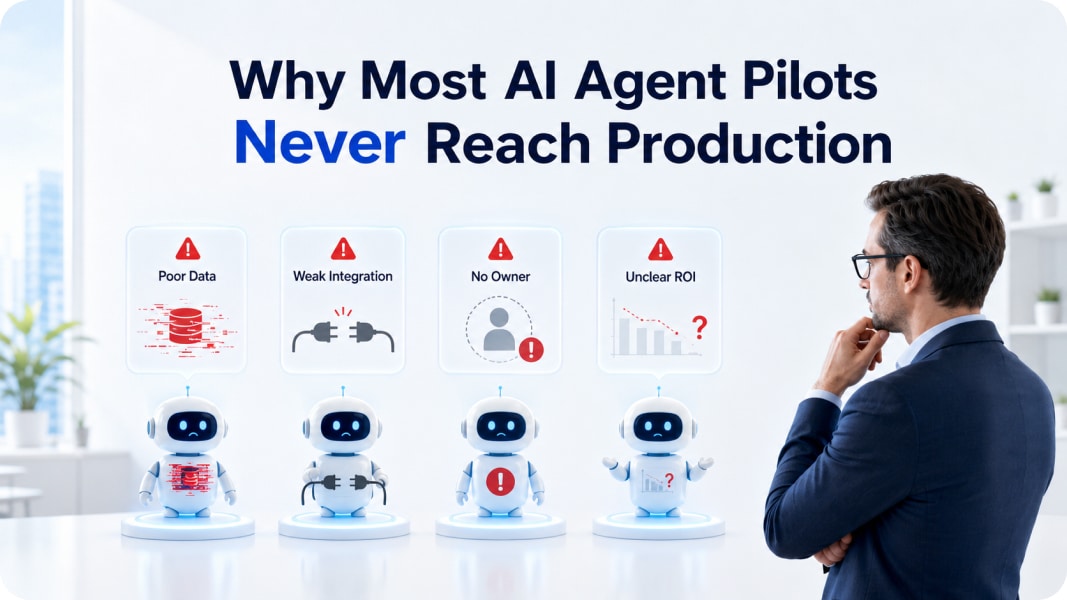
Why Most AI Agent Pilots Never Reach Production
For many companies, building an AI agent prototype is relatively easy. A team can connect a model to a dataset, create a simple workflow and demonstrate an impressive result in a matter of days.
The harder question is what happens afterward.
A successful demonstration does not automatically mean an AI agent is ready to operate inside a real business environment. Production systems have to deal with incomplete data, permissions, exceptions, existing workflows, security requirements and the consequences of taking the wrong action.
This is why many AI agent pilots never make the transition from demonstration to daily business use.
The Prototype Usually Solves a Smaller Problem
An AI pilot is often built around an ideal scenario.
For example, a company might demonstrate an agent that looks up customer information and generates a sales summary. The test works because the data is clean, the request is clearly defined and there is little risk if the result is incorrect.
The production environment is different.
Real employees may ask ambiguous questions. Customer records may be incomplete. Information may be distributed across a CRM, ERP and other systems. Some actions may require approval.
The gap between these two environments is often where AI projects become difficult.
Business Data Is More Complicated Than the Demo
AI agents depend on access to reliable business information.
A sales agent, for example, may need information from a CRM about customer interactions, an ERP about orders or invoices, and another system containing product information.
If the agent can access only one of these systems, it may provide an answer that is technically reasonable but operationally incomplete.
Data quality creates another challenge.
Duplicate customers, outdated records, missing fields and inconsistent naming can all affect the result. AI does not automatically determine which business record is correct simply because it can understand natural language.
Before moving into production, companies should therefore evaluate the quality and availability of the data the agent will use.
Access and Permissions Become Critical
A pilot can often operate with broad access because the environment is controlled.
Production systems cannot.
An AI agent helping a salesperson prepare for a meeting may need access to customer history, open opportunities and recent communications. It may not need access to unrelated accounts or confidential financial information.
The principle should be simple:
Give the agent enough access to perform its job, but not more than it needs.
The same applies to actions.
Reading an invoice is very different from changing its status. Preparing a customer email is different from sending it. Creating a purchase order is different from recommending that one should be created.
These distinctions need to be defined before deployment.
Production Requires More Than Information Retrieval
Many pilots demonstrate that an AI system can retrieve information.
Production systems often need to do more.
Consider a simple sales workflow:
- A lead enters the CRM.
- The agent evaluates the available information.
- It identifies missing information.
- It creates a follow-up task.
- It updates the appropriate CRM fields.
- It notifies the relevant employee.
Now the AI is no longer simply answering questions. It is participating in an operational process.
That introduces the need for rules, approvals, error handling and monitoring.
Exceptions Are Where Production Systems Are Tested
A workflow can work perfectly when everything goes according to plan.
The real test comes when something unexpected happens.
What happens if the customer already exists in the CRM?
What if the ERP contains a different address?
What if a required field is missing?
What if the requested action exceeds an employee’s permissions?
What if the AI is uncertain?
A production-ready AI agent needs a defined response to these situations. Sometimes that response should be another automated step. In other cases, the correct response is to stop and ask a human to review the situation.
How to Move From Pilot to Production
The transition should be gradual.
Companies can begin with a process that is repetitive, measurable and relatively low risk. The agent can first retrieve information, then provide recommendations, then prepare actions for approval.
Only after the workflow has demonstrated consistent performance should selected actions become automated.
A useful progression is:
| Stage | AI Role |
| 1 | Retrieve information |
| 2 | Analyse and recommend |
| 3 | Prepare an action |
| 4 | Execute approved actions |
Not every workflow needs to reach the fourth stage.
The objective is not maximum autonomy. It is reliable automation.
The Real Measure of Success
An AI agent pilot should not be considered successful simply because the technology works.
The better question is whether the agent improves an actual business process.
Does it reduce manual work? Does it shorten response times? Does it improve data consistency? Does it reduce the amount of time employees spend moving between systems?
When those questions have measurable answers, an AI pilot has a much better chance of becoming a production system.
For companies evaluating whether their workflows are ready for this transition, AI Agents can provide a useful starting point for understanding how AI agents can operate alongside existing business systems.
Once a repair is complete and the customer has approved the quotation or fixed price, SAP generates a billing document to finalize the financial side…

If there were rules about how software should look, Microsoft Dynamics would wear a three-piece suit, a tie, and maybe even a pocket watch. This…

In this guide we will learn how to connect Noca AI to your monday account. 1. Log into Noca. 2. Under the Flows menu locate…