
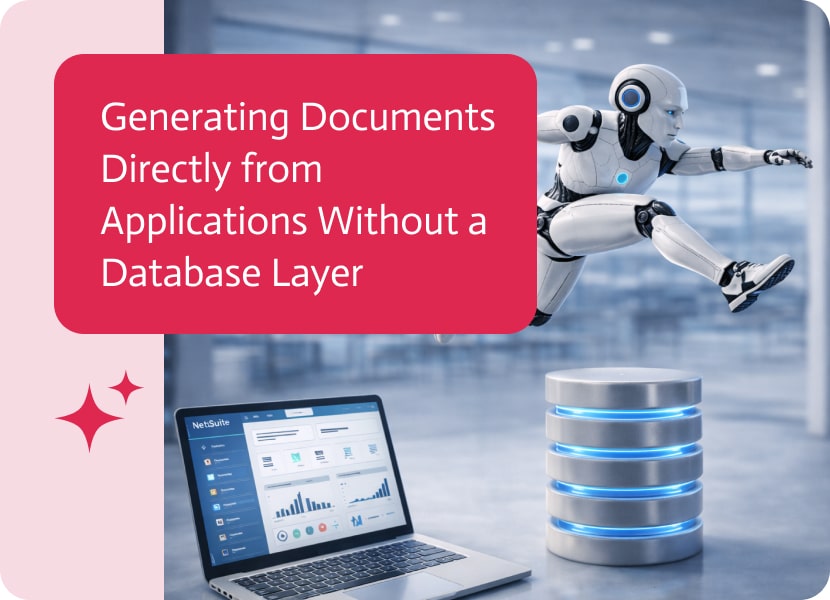

Generating Documents Directly from Applications Without a Database Layer
In many applications, generating documents is a common requirement. Businesses often need to produce PDFs such as confirmations, reports, summaries, agreements, or application results based on information entered by users.
Traditionally, this process depends heavily on a database-driven workflow. Data is first stored in a database, then retrieved, merged into a template, and finally exported as a document. While this model works well in many scenarios, it also introduces additional complexity.
Today, new approaches are emerging that allow documents to be generated directly from application inputs, without requiring the data to pass through a database first.
The Traditional Database-Based Approach
Most document generation systems follow a similar pattern. When a user fills out a form or interacts with an application, the data is stored in a database before it can be used to generate a document.
A typical process might look like this:
- A user enters information into an application form
- The data is stored in a database
- A document template retrieves the stored data
- The document is generated and exported as a PDF
While this architecture ensures structured data management, it also means that document generation depends on several intermediate steps.
In situations where the goal is simply to produce a document based on user input, this workflow can feel unnecessarily heavy.
When Documents Don’t Need a Database
Not every document requires permanent data storage. In many cases, the goal is simply to capture information and immediately generate a formatted document.
Examples include:
- Generating a confirmation document after a form submission
- Creating a summary report from a short workflow
- Producing a signed agreement or declaration
- Exporting information entered in a temporary process
In these scenarios, storing the data in a database before generating the document may add complexity without delivering real value.
Generating Documents Directly from App Inputs
A more streamlined approach allows applications to generate documents directly from the information currently available in the interface or workflow.
Instead of routing data through a database, the application can:
- Capture the input provided by the user
- Insert the values into a predefined document template
- Generate the final document instantly as a PDF
This process removes the dependency on a storage layer and allows documents to be produced immediately.
The Role of Document Templates
Templates still play an important role in this approach. By defining the structure of the document in advance, applications can automatically insert dynamic values from the user’s input.
Templates might include:
- Titles and headings
- Placeholder fields for dynamic content
- Tables or structured sections
- Branding and formatting elements
When the document is generated, the application simply fills these placeholders with the relevant data and exports the finished file.
Faster Workflows and Simpler Architecture
Removing the requirement for a database in document generation can significantly simplify application workflows.
This approach can help teams:
- Generate documents faster
- Reduce system dependencies
- Simplify application architecture
- Avoid unnecessary data storage
It is especially useful in lightweight processes where the main goal is document output rather than long-term data management.
Rethinking Document Generation in Modern Apps
As modern application platforms evolve, developers and builders are finding new ways to streamline common processes. Generating documents directly from application inputs is one example of how workflows can be simplified without sacrificing functionality.
By removing unnecessary steps and allowing documents to be created immediately, applications can deliver faster and more efficient experiences for both users and builders.
If you look out the window of your digital life right now, you can see it, a monstrous AI monsoon. The storm began in the…

While Zapier is an excellent tool for small businesses and non-profits, medium to large enterprises may find it lacking in scalability and depth. Here are…
What Is A Copywriter? A copywriter is an individual who specializes in creating professional, engaging written content that drives action. This can be product descriptions…