
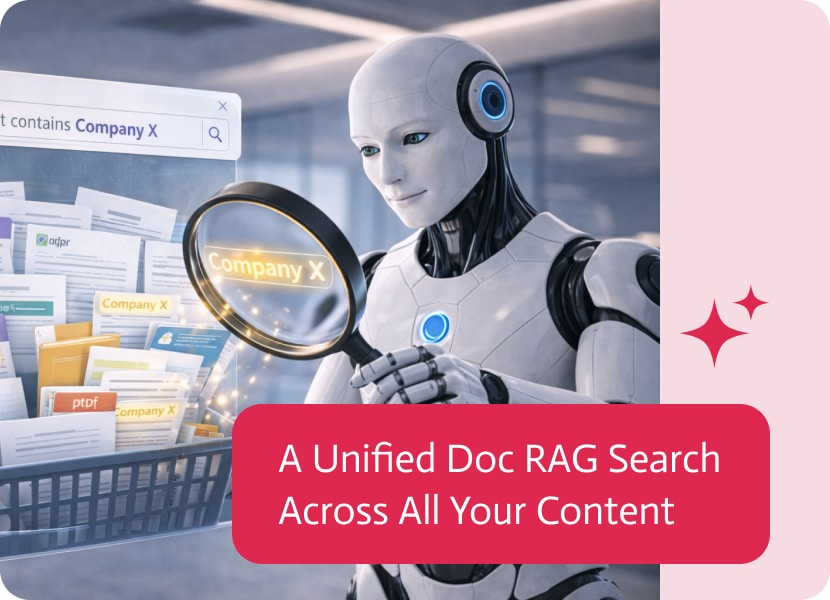

A Unified Doc RAG Search Across All Your Content
Finding the right information shouldn’t feel like searching in ten different places at the same time. Yet in many workflows, content is scattered—across files, documents, and systems—making it harder to get clear, consistent answers.
What if you could search everything together, as if it were one source?
From Fragmented Searches to One Unified View
Traditionally, searching across multiple documents meant running separate queries for each one. While this works, it can lead to mixed results, repeated effort, and answers that don’t always align.
Now, there’s a simpler way.
By combining multiple content sources into a single search, you can treat all your information as one connected knowledge base—no matter where it lives.
One Question, One Answer
Instead of asking the same question multiple times, you ask once—and get a unified response.
For example:
- Pull insights from several documents in a single step
- Get more consistent answers across different data sources
- Reduce gaps or contradictions between results
It’s faster, clearer, and far more efficient.
Better Context, Better Results
When information is searched together, the system has more context to work with. That means responses are not only quicker, but also more accurate and complete.
Rather than piecing together fragments from different places, you get a more holistic answer—one that reflects the full picture.
Less Effort, More Clarity
This shift removes a lot of the friction from working with content:
- No need to manage multiple searches
- No need to compare separate results
- No need to guess which source has the “right” answer
Everything comes together in a single, streamlined experience.
A Smarter Way to Work with Knowledge
As teams rely on more data than ever, the ability to search across it effortlessly becomes essential.
By moving from individual searches to a unified one, you’re not just saving time—you’re making knowledge easier to access, understand, and act on.

Most enterprises default to a text chatbot without ever asking whether the interaction they’re automating should really be spoken. That default choice costs conversions more…

Priority is full of answers and strangely good at hiding them behind the exact screen you are not on. When someone asks who the last…

Salesforce lead management is often well defined, but Salesforce lead notifications do not always match how modern sales teams actually work. In many organizations, lead…