

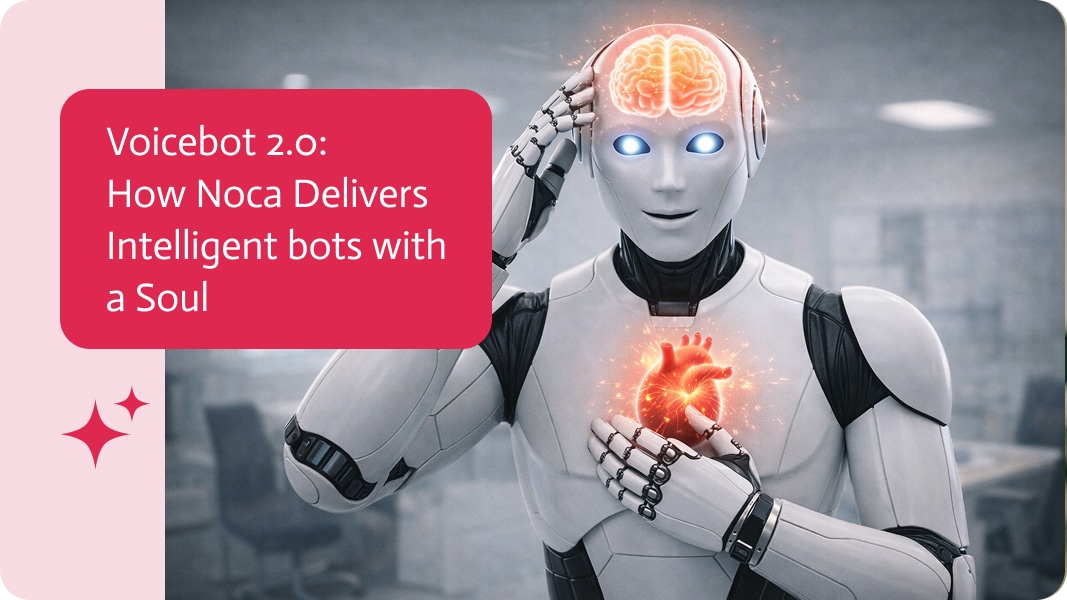
Voicebot 2.0: How Noca Delivers Intelligent bots with a Soul
If you say the word “Voicebot” quietly in a room full of business owners, you will probably see one of three things happen: people will shudder in fear, roll their eyes, or suddenly want to throw their phone across the room.
We have all been hurt. We have all yelled “REPRESENTATIVE!” at a soulless algorithmic wall that politely refuses to understand us. For almost twenty years, the Voicebot has been pretty much like a digital mosquito, annoying, persistent, and something you want to get rid of as soon as possible.
Voice technology is going through a new golden age. Take Noca, which isn’t just fixing the holes in the old, sinking ship of IVR (Interactive Voice Response) but building a brand new ship and changing the definition of a voicebot by moving away from “decision trees” and toward “personality engines.”
“Old” vs. the “New” Voicebot
We need to look at the autopsy of a legacy voicebot to understand the leap forward.
The old version was based on keywords. You said “Billing,” and it took you to billing. If you said, “I’m really mad about a charge on my bill that I didn’t agree to,” it would have heard “Blah blah blah BILLING blah blah” and sent you to the same place. It had no memory, no context, and no chill.
The modern voicebot is based on semantics and meaning. It gets the mood and knows that “I guess I have to upgrade” means that the person is reluctantly buying something, while “I suppose I could upgrade” means that the person is ready to buy.
The Secret Sauce: Vibe Coding
Most of the time, making software is boring. There are brackets, semicolons, and a lot of caffeine involved. But Noca changes the voicebot game with “vibe coding.”
This is exactly what it sounds like. You don’t program a bot with logic gates (should the user say yes > go to Step 4); instead, you program it with personality prompts. You’re basically hiring an actor for a part.
Here’s how it would work if you ran a surf shop:
The Old Way: You pay a developer to make a menu. Press 1 for shortboards. Press 2 for longboards.
You open the dashboard and type: “You represent ‘Hang Ten Rentals.'” You are a calm, helpful expert on surfing. You use slang like “stoked” and “gnarly,” but not too much. To recommend a board, check the stock, and book it, you need to know the customer’s height and weight. Tell them that the only sharks around here are the loan sharks at the bank next door if they ask about them.
That is the code and all the instructions as well.
The Noca Voicebot uses that text to create a character. It doesn’t just read a script; it makes things up within the limits you set for the character. It makes for a memorable, funny, and surprisingly useful customer experience. Now, anyone can build a world-class voice interface with just a good imagination. You don’t need a computer science degree to do it.
The “Barge-In” Factor: Why Interruptions Are Important
There is a subtle psychological reason why talking to old robots felt fake: you couldn’t stop them from talking.
People talk to each other in a messy way, and we’re always talking over each other.
- Human: “I need a flight to Boston. Oh, wait, I mean Austin.”
- Legacy Bot: “Looking for flights to… Boston.”
- Human: “No, Austin!”
- Legacy Bot: “I didn’t get it. Looking for flights to… Boston.
Noca’s Voicebot technology works best here because it supports “barge-in” with low latency. The AI is listening while it talks. If you stop it, it stops right away, processes the new information, and changes direction.
The bot will stop talking and say, “Got it, switching to Tuesday,” if you say, “Actually, looking at the prices, let’s switch to Tuesday.” Let’s take a look at what we have…
It may seem like a small technical detail, but it makes all the difference between being frustrated and going with the flow. It gives the Voicebot the impression that it values your time.
From Chatterbox to “Doer”
A voicebot that only talks is like a podcast you can yell at. It needs to have hands (figuratively speaking) for it to be useful in business.
Noca puts a lot of emphasis on “Actionable AI.” This means that the Voicebot is more than just a talker; it can also use tools. The bot is making API calls, checking databases, and updating records while you and your friend talk.
Let’s look at a “lead reactivation” situation, which is a common problem for sales teams.
You have a list of 5,000 leads who asked about your services six months ago but haven’t followed up. No one wants to call them. It’s work that breaks your heart. You start up a Noca Voicebot. You let it see your calendar and your CRM. The leads get calls from the bot.
- Bot: “Hey Sarah, this is Alex from Acme Solar. I saw you looked at panels a while back and didn’t pull the trigger. Energy prices just hiked again, so I wanted to see if you were still paying too much for power.”
- Sarah: “Yeah, honestly, my bill is huge. But I’m busy right now.”
- Bot: “Totally get it. I can see a slot on our specialist’s calendar for tomorrow at 4 PM or Thursday morning. Want me to grab one of those so you don’t have to play phone tag later?”
- Sarah: “Thursday works.”
The Voicebot did three things in that conversation: it qualified the interest, it dealt with an objection (“I’m busy”), and it used a complicated tool to book a meeting in a real-time calendar. It turns a database that isn’t being used into money without anyone having to do anything until the appointment actually happens.
The Speed of Thought (Latency)
We need to talk about the weird pause. You know what I mean. When you ask Siri or Alexa a question, there is a three-second pause where you wonder if the internet is down. When you’re on the phone with customer service, that three-second pause seems like forever. It shatters the illusion of being smart.
A Noca Voicebot doesn’t have to “go to space and back” to get the answer. The conversation moves along at a normal pace. This is very important in high-stakes markets like emergency dispatch, where people don’t trust each other when they hesitate.
When the Voicebot cuts down on the “thinking time,” it stops feeling like a machine processing a question and starts feeling like a smart agent answering a question.
The “Prompt to Worker” Change
We talked about “Vibe Coding,” but Noca is taking it a step further with the idea of “Prompt to Worker.” At this point, the Voicebot stops being its own thing and starts to lead an orchestra.
You can tell the system not only to talk but also to create “workers,” which are specialized sub-agents that do certain jobs.
- The Voice Face: The main voicebot talks to the customer. It’s polite, charming, and well-spoken.
- The Math kid: If a client asks for a complicated mortgage calculation, the Voicebot sends the information to a “worker” agent who is good at math. The worker then sends the answer back to the voicebot.
- The Librarian: When a client asks about a certain clause in a 50-page PDF contract, a “Worker” agent reads the whole thing right away and sends the answer to the Voicebot.
With this approach, your voicebot doesn’t have to be an expert in everything; it just needs to know who to ask. It looks like a real office. The receptionist doesn’t know how to fix the server, but they do know who to call to get it done.
The Future is Voice with No Code
The most exciting thing about this Voicebot revolution is that it makes the technology available to everyone. If you wanted a custom AI voice assistant for your pizza shop two years ago, you needed a team of developers and $50,000.
Today, with Noca, you need a prompt.
“You are the Pizza Bot. You really like extra cheese. You take orders, try to sell people garlic knots, and if someone asks for pineapple, you jokingly judge them but still take the order.
This easy access is going to lead to a huge rise in creativity. Local libraries and indie bands will use voicebots to promote their albums, and nonprofits will use them to get volunteers.
Final Thoughts on Voicebots
People no longer think of the Voicebot as a bad word. It has gotten a PhD in social skills after going through a lot of tough times.
Noca is at the front of this movement because they understand that voicebots aren’t about better speech-to-text, they’re about better brains-to-speech. It’s about making voicebots who understand the situation, do their jobs, and deal with the messy and beautiful way people talk to each other.
If you hear a voice on the other end of the line that is helpful, funny, and surprisingly quick, don’t hang up right away. You could be talking to the future. And if you ask nicely, it might even joke around while it works on your refund.

The Salesforce Slack Integration is a robust solution that combines Salesforce, a leading customer relationship management (CRM) platform, with Slack, a powerful workplace communication tool….
Most monday.com rollouts hit the same wall: the people who need the information are not the people who should live inside monday.com all day. Giving…
They’ve been sneakily popping up everywhere, haven’t they? Now, they’re hard to miss, popping up all over the internet. Seriously, whether you’re buying stuff online,…