

The Disconnect Between AI Hype and Operational Reality
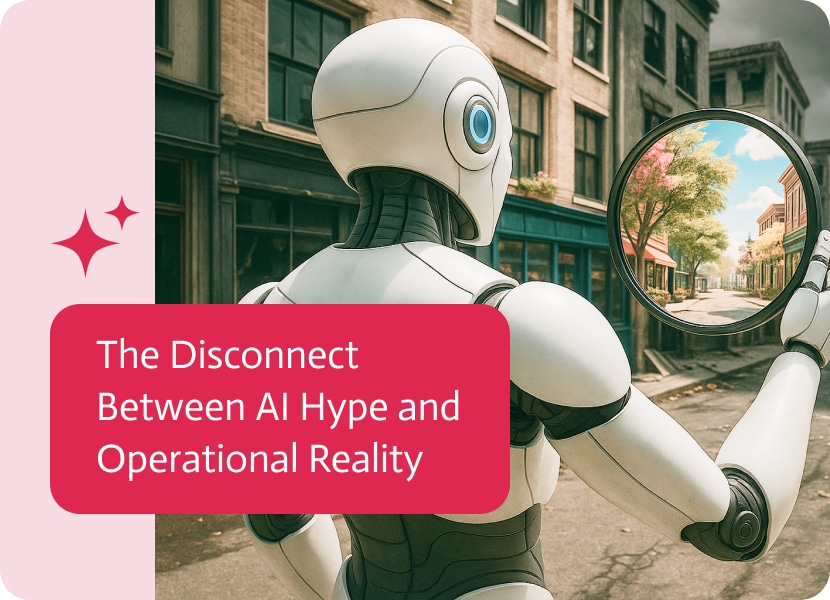
A drizzle of toxic rain hangs over the landscape that looks like salvation from afar, but up close it pits the metal and stings the skin. That’s the kind of weather AI hype has soaked the global economy in. To the average observer, and even to plenty of board members who should know better, it all seems like some glorious storm of transformation. Capital floods toward generative AI, SaaS valuations orbit around “AI strategy” instead of revenue, and the media behaves as if the future already arrived and forgot to knock.
But the CIO, CISO, and enterprise architect see things very differently. The consumer market is full, but the business ecosystem is still dry. We are seeing a deep paradox: even though there are a lot of AI tools on the market, businesses are not using AI to its full potential.
IT leaders aren’t failing to use their imaginations when they don’t see this. Instead, it is the result of a logical clash between the unstoppable force of hype and the unmovable object of operational reality. Board members are putting a lot of pressure on executive teams to “adopt AI” to show shareholders that they are open to new ideas. But when these rules get down to the level of architecture, they run into the strict rules of governance, compliance, and technical debt.
At the moment, we are in “Pilot Purgatory.” We have thousands of proof-of-concept (PoC) projects running in sandboxes, but very few production-grade workloads that handle important business logic. It’s not that we don’t want the water; it’s that the “rain” that falls from the startup environment is mostly toxic from a risk point of view.
“Toxic Assets”: The Hidden Cost of Rapid Adoption
The current boom in artificial intelligenceI startups, which are popping up like mushrooms after a storm, is a big problem in enterprise AI governance. Vendor risk management is a planned process in a stable procurement cycle. It is a minefield today.
The “Radioactive” Ecosystem
We are seeing a lot of what can best be called “wrapper” companies. These are new businesses that are basically thin UI layers atop foundation API (usually OpenAI or Anthropic). These tools are useful right away, although there is a high probability they’ll make the enterprise stack very unstable.
From a strategic point of view, a lot of these vendors are “toxic assets.” They don’t have the strong corporate structure that is needed for enterprise partnership. They often don’t meet SOC2 Type II standards, they don’t have much time left, and their main selling point is just one API update away from being useless. Putting these tools into a critical workflow creates a weak dependency chain. If a startup changes direction, runs out of money, is bought, or shuts down, the business process that was built on it falls apart.
Using these resources doesn’t automatically imply that you’re being innovative; it just indicates you’re taking on more technical and seller risk. The “rain” is radioactive because it carries the things that make things unstable. We are being told to build skyscrapers on bases that could fall apart in six months.
The Trend vs. The Trust
Also, there is a basic difference between the “cool factor” that drives market hype and the reliability needs of the business. In the world of consumers, a ai chat bot that sees things that aren’t there 5% of the time is a quirk. In business, a 5% error rate is a disaster.
Credence and reliability are the business’s currency. In heavily regulated sectors like legal services, LLM security policies must ensure deterministic outcomes or, at the very least, explicable probabilistic results. A text summary tool that leaves out an important clause in a contract or a diagnostic support tool that makes up a symptom creates a liability that is much bigger than the value of the time saved.
The market is selling “magic,” but the business needs “auditable accuracy.” The risk profile of these assets is still too high for use in core business functions until the gap between plausible outputs and verified outputs is closed.
Shadow AI 2.0: The Problems with App Builders That Use Prompts
The threat vector has changed. “Shadow AI,” which was when digital employee pasted data into public chatbots, was the main worry in 2023. “Shadow AI 2.0” is coming in 2025, and it will be the rise of prompt-based app builders.
The Architectural Gap
Tools like Lovable, v0, or different internal “app builder” agents are great for quickly making prototypes. They let people who aren’t tech-savvy create functioning interfaces and basic logic by using natural language prompts. But thinking of these as ready-to-use solutions is a dangerous mistake.
Most of the time, these tools don’t follow the usual Software Development Life Cycle (SDLC). They don’t follow the strict rules we’ve set up for a reason. A prompt-generated app doesn’t often have:
- Identity and Access Management (IAM): Often, integration with Okta/Azure AD is an afterthought, which can lead to hardcoded credentials or weak authentication.
- What happens when the API fails? How do you handle errors? What happens if the input data isn’t in the right format? Code that is generated doesn’t often handle edge cases well.
- Observability: How do we keep an eye on performance? Where are the records?
When a department head uses a prompt-based builder to make a “customer tracker,” they are making software that doesn’t have any management. There is no owner, no plan for maintenance, and no security audit. This situation results in an accumulation of immediate technical debt.
The Integration Silo
The more serious issue is that data silos are being established. It’s even harder to integrate AI when apps are built entirely independently.
An application made by a prompt usually lives on its own. It might let you upload a CSV file, but it doesn’t often have the complex and secure integration logic needed to write back to the ERP (SAP, Oracle) or the CRM (Salesforce). If it does, it’s usually not safe.
We run the risk of making a fragmented landscape of thousands of “micro-apps” that can’t talk to each other and can’t be managed from one place. This is the opposite of the unified digital transformation plans we’ve been working on for the past ten years. An app that can’t safely connect to the enterprise data fabric is a problem, not a benefit.
The “AI Agent” Fallacy in Complex Environments
The perspective of those in the industry has changed from “Copilots” (human assistance) to “Agents” (who perform independently). We are promised that digital workers will be able to manage complex assignments. But in the context of complicated business settings, this is simply not true right now.
Task Automation vs. Process Orchestration
We need to know the difference between a “task” and a “process.”
- A task is one and only one: “Write a reply to this email” or “Summarize this PDF.”
- A process is made up of several steps, depends on the state, and is transactional: “Bring on this new vendor, update the SAP ledger, start the legal review in CLM, and let the procurement officer know.”
Today’s AI automation agent are great at tasks but not so great at processes. The cause is a lack of state management and deep integration. To successfully navigate a “process,” an agent needs to be able to deeply connect to the “source of truth” systems through APIs. It needs read/write access that is strictly controlled by Role-Based Access Control (RBAC).
Most of the current agentic frameworks are only working on the surface. They are “vision-based” or work through browser dominance instead of strong API integration. They don’t have the bigger picture of how the business works. If an agent sends an email to a client but doesn’t update the CRM record of that interaction, it means that the business is not working as it should.
AI agents will only be able to do low-risk, administrative tasks until they can be trusted to keep transactions honest and make sure that a multi-step process either fully succeeds or fully rolls back without corrupting data.
Data Sovereignty and the Non-Negotiable Requirements
The security perimeter is what really stops businesses from adopting new technologies. The “OpenAI Wrapper” era, when businesses sent data to public endpoints without much thought, is coming to an end.
The Security Perimeter
Data sovereignty is not a choice; it is a rule that must be followed. For global businesses that have to follow GDPR, CCPA, or industry-specific rules (HIPAA, SOX), the idea of sending private data to a “Black Box” SaaS model is a no-go.
The business need is total control. We are moving toward a model in which the AI must come to the data, not the other way around. This necessitates:
- Deployment of a private VPC: The model needs to work in the company’s own cloud environment, like AWS, Azure, or GCP.
- Zero-Retention Policies: Contractual and technical promises that the model provider won’t keep any data after inference.
- On-Premise Options: For the most sensitive data, like defense and banking core, we are seeing a return to on-premise hardware (NVIDIA DGX clusters) running open-source models (Llama 3, Mistral) to keep the data safe from outside threats.
Control and Auditability
Last but not least, there is the issue of being able to audit. In a business setting, if it isn’t written down, it didn’t happen.
When decisions are made without an audit trail, the risks of shadow AI are highest. We need an architecture with a “human-in-the-loop” where we have accessibility to every model output. We need to know:
- Which user prompted the model?
- What documents were found (RAG)?
- Which version of the model was used?
- Why did the model come up with this particular output?
- We can’t explain our choices to auditors or regulators without this level of detail.
Conclusion: The Path to Prudent Adoption
When we stop thinking of AI as a magic wand and start thinking of it as IT infrastructure, the “AI Paradox” goes away. The “rain” of new tools will eventually help the business grow, but only after we have built the reservoirs and filtration systems to handle it.
We shouldn’t give in to the market’s need for new things by using “toxic assets.” Instead, we need to concentrate on the boring, basic tasks, like making sure our data pipelines are secure, setting up strict governance frameworks, and making sure our vendors follow enterprise-grade rules.
A sudden flood of flashy tools won’t be a sign of true enterprise penetration. Instead, intelligence will be quietly, safely, and carefully built into the core of our operations. For now, we’ll keep our firewalls tight and our umbrellas up.
Author:
Gian Pierre Golden, Senior Content Writer at Noca AI since 2025
When he’s not diving into the nuances of AI, he’s diving into the Atlantic Ocean caressing the idyllic shores of Cape Town, South Africa

It’s a whole new way to build software. The basic idea is to turn everyday thoughts, whether you type, say, or draw them, into code…

The art of letting artificial intelligence do all the boring stuff so you can focus on growing your business. What Exactly is B2B Sales Automation?…
In today’s business world, efficiency drives success. Companies of all sizes depend on smooth workflows to manage customer relationships, internal operations, and communications. One of…