


Bolt vs. Lindy AI: The Vibe Check
Stop fighting with syntax and start building with vibes. We are now in the golden age of Vibe Coding, a time when your ability to remember documentation is less important than your creative intent. Here we’ll look at Bolt vs. Lindy AI, two up-and-comers going head-to-head in this comparison.
Bolt is a lightning-fast browser environment that turns rough ideas into deployed full-stack apps in seconds. Lindy AI is an autonomous workforce builder that makes digital workers who not only write code but also do the work. The barrier to entry has been broken down, whether you want to make a prototype for a startup during your lunch break or automate your whole life.
Welcome to a future where English is the world’s most powerful programming language and Bolt vs. Lindy AI are using it to their advantage.
Bolt: A Developer Playground
With Bolt.new, you can enter text prompts to make a working application codebase from scratch. Then, you can add changes and change the source code in Bolt’s browser-based IDE. Bolt was made by StackBlitz, but it’s aimed at a different group of developers: those who know how to code but don’t like setting things up.
Bolt is based on StackBlitz’s WebContainers technology and gives you a full development environment where you can set up backends, install NPM packages, and connect to databases like Supabase. This is what makes Bolt different from simpler generators: you are working in a real development environment that AI speeds up.
What Bolt Does Right
If you’re already familiar with web development, the vibe coding workflow here should feel natural. Bolt lets you use frameworks like Astro, Vite, Next.js, Svelte, Vue, and Remix right from your browser, so you don’t have to worry about setting them up.
Bolt turns plain English into full-stack apps in minutes, with no installations or steep learning curves, just pure, unadulterated creation. You don’t really need a local environment because the IDE is in the browser, so you can code from anywhere.
The platform is great for quickly creating prototypes, so Bolt is a great choice for developers who need to quickly make proof-of-concept apps or who want to make sure their ideas are good before they spend a lot of time on them.
What Bolt Does Wrong
This is something that everyone who is thinking about using Bolt should remember. It doesn’t give the smooth development experience it promises, and it causes new problems with code generation and deployment that aren’t always easy to predict. Also, token allowances go away faster than expected.
There is friction with the token-based pricing model. Users say that when projects get bigger than simple prototypes, they run into a lot of problems, like needing a lot of tokens to debug. It looks like one developer used up 20 million tokens trying to fix just one authentication problem.
Known Limitations
While Bolt has dramatically improved with v2, vibe coding still has inherent limitations. Complex apps with detailed business logic may hit walls where AI-generated code becomes a problem to debug and extend. Projects needing high performance, custom algorithms, or integration with some of the older systems from 1987 might still need actual human developers.
Think of it this way: Bolt is good for building a food delivery app. Building the next Google search algorithm? Maybe hire some engineers.
Choose Bolt when:
- You already know the basics of web development.
- You want to avoid boilerplate code but still have control over the architecture.
- Your projects need certain frameworks or a high level of technical skill.
- “Help me code faster” is what vibe coding means, not “code for me.”
- You know how to debug and work with generated code without any problems.
- Rapid prototyping is more important than polishing for production.
Lindy AI: The Agent Platform That Wants to Work with You
Lindy AI approaches vibe coding with something slightly different in mind. They asked, “What if you didn’t need to build apps at all?” What if you could just tell AI agents what to do, and they would do it on their own?
You’re able to create “AI employees” on the platform without having to code. Lindy AI is about automation for AI agents that doesn’t require any coding. It can handle complicated business processes like qualifying leads via CRM and sorting support tickets and sending them to Slack. You’re not really making any software, you’re more like hiring people to work online, if that makes sense?
What Lindy Has Going for It Right Now
By October 2025, Lindy will be using Claude Sonnet 4.5 as its default mode, which got a 77.2% SWE-bench score. It also has Claude Sonnet 3.7, GPT-5, GPT-5 Codex, Gemini Flash 2.0, and Claude Haiku 3.5. Choosing the right model can help you find a balance between cost and capability, which affects both performance and credit use.
The Claude Sonnet 4.5 integration lets agents work on technically challenging tasks for more than 30 hours without help, with much better coding accuracy. This matters because your agents genuinely deal with sophisticated workflows, so there’s no need for supervising them all the time.
Lindy just released Agent Swarms, which lets one AI agent make copies of itself to do more things simultaneously, like sending hundreds of emails, or even when you need to be carrying out several calls at the same time. That’s how the new age agents can work faster and on a larger scale than people can.
As of now, Lindy works with more than 6,000 apps, including Workspace, Salesforce, Slack, HubSpot, Shopify, and Stripe. Lindy’s Computer Use feature lets agents automate their browsers and move around sites, fill out forms, and get data from any web app. This is useful for platforms that don’t have APIs.
Lindy is certified to meet SOC 2 Type II standards, allowing its use in many industries needing AES-256 encryption. Business Associate Agreements for healthcare, enterprise SSO, role-based access controls, and full logs are just a few security features you’ll have access to.
Where Vibe Coding With Lindy Hits Friction
Lindy charges based on credits, and each agent’s action takes money out of a monthly credit balance. Sending a message only costs a few credits (7 for an email), but longer jobs or multi-step workflows cost more (265 for a short phone call). For complicated automations, credits can run out faster than you think.
One important limitation is that agents are not fully equipped to deal with those really weird scenarios in a predictable way, meaning decision trees that are not straightforward will need to be set up carefully, AI responses differ wildly sometimes, and tasks that need human judgment should have escalation channels. Lindy is best for technical work that requires a thorough comprehension of the context, instead of only mechanical tasks.
Some users say that Lindy is great for companies that need smart automation without a lot of technical complexity. However, enterprise controls like role management, records, and version tracking are still being built. Governance features may not be very useful, especially for those bigger teams that have to handle sensitive workflows.
When to choose Lindy AI:
- You want to automate processes that are already in place, not create new software.
- Your vibe coding says, “Get me AI workers who can do things.”
- Connecting with more than 6,000 existing business apps is very important.
- You need agents that can work on their own with email, CRM, Slack, and other tools.
- You must have compliance certifications like SOC 2, HIPAA, and GDPR.
- You want to get rid of repetitive work, not make new apps.
How Noca Fits into the Vibe Coding Ecosystem
Noca is a no-code, AI-first platform made for making and running AI agents and business workflows. It links together CRMs, ERPs, and older systems, which is a common problem with enterprise automation projects. It also lets teams say what they want in plain language and then deploy agentic workflows that keep running and learning.
In real life, Noca’s strengths are orchestration, enterprise connectors, and agent monitoring. These are the parts of vibe coding that matter when a program needs to update Salesforce, start an ERP process, and show errors to a human reviewer. That doesn’t mean it hasn’t gotten into making really smart autonomous chatbots that act like a vibe-coding tool, though. Noca is a complete tool that can help you make anything from a simple app to something much more complicated.
Vibe coding really pays off for businesses when it comes to tools that can automate across a company’s entire tech stack, not just make front-end prototypes, making it a clear winner when compared to Bolt vs. Lindy AI.
The Verdict: Bolt vs. Lindy AI
Here’s what nobody talks about in platform’s comparison. A tool’s origins fundamentally shape what it’s good at, regardless of how it evolves. Lindy was built as a personal productivity assistant, and that foundation shows in everything from the design to the approach to the pricing model.
Is Lindy bad? No. For individual productivity automation, it’s actually quite good. The template marketplace makes getting started easy, the natural language setup works well for rudimentary workflows, and the credit system (once you understand it) provides a certain amount of elasticity for variable usage.
But there’s a massive gap between “good for personal productivity” and “ready for business-critical automation.” Reviews consistently note this distinction. Lindy works well for email sorting, calendar management, and simple task automation. But you can see it battle with business logic, sophisticated integrations, and the kind of mission-critical workflows that businesses actually need digital employees to handle.
Bolt v2 includes enterprise-grade infrastructure with databases, hosting, SEO boosts, and audits, letting projects scale from first user to first million. Bolt’s collaboration features center on collaborative app development, shared workspaces, GitHub integration, and project forking so devs can work on applications together.
The vibe coding revolution is still young. But Bolt vs. Lindy AI reveal two complementary visions: on one hand, AI employees handle our business processes so we can divert more of our attention to strategy and creativity, and on the other, anyone can build the applications they imagine, democratizing power previously held by developers.
The question isn’t whether vibe coding will transform work, it already has. The question is whether you need AI employees to run your business almost automatically. Understanding this distinction is key to deciding the direction of your vibe coding journey.
In the dynamic world of Integration Platform as a Service (iPaaS), choosing the right solution can significantly impact your business operations. Today, we’re comparing two…
Let’s jump into the exciting world of hiring, where HR departments sprint marathons and new hires are tossed into the corporate deep end with little…
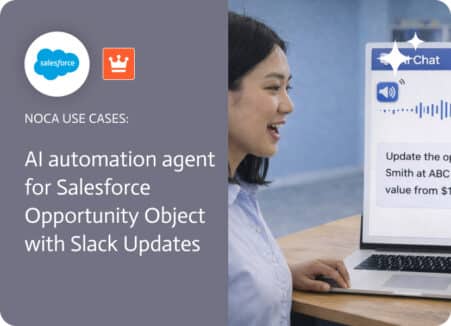
The Salesforce opportunity object is where deal reality lives: stage, amount, close date, ownership, and all the little changes that indicate whether a deal is…