
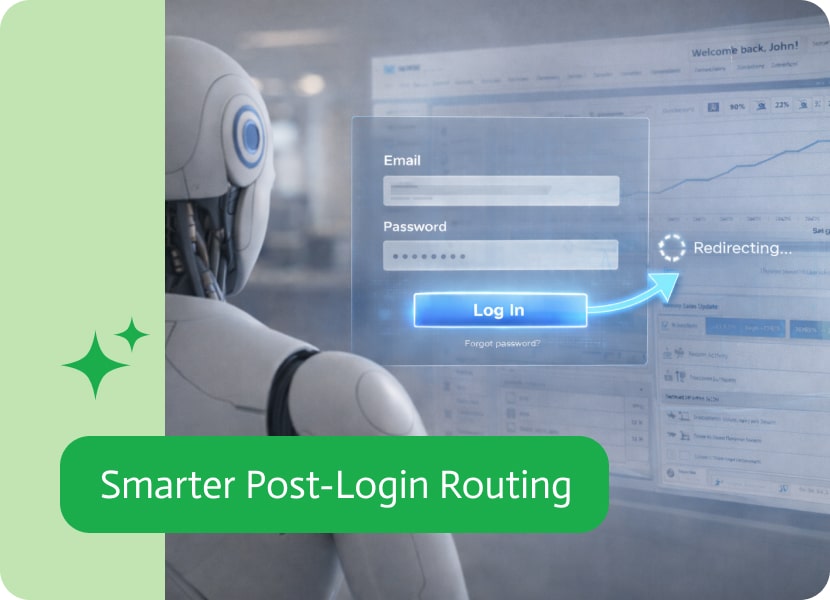

Smarter Post-Login Routing
In many digital applications, the login experience is treated as a simple gateway — a necessary step before users can access the system. But what happens immediately after login is just as important as authentication itself.
Without a clearly defined destination, users can land on generic pages, incomplete dashboards, or even dead ends. This creates friction at the exact moment when clarity and direction are most critical.
The Problem with Undefined Post-Login Navigation
In some systems, adding a login page does not automatically determine where users should go after successfully signing in. When no explicit redirect is configured, several issues may arise:
- Users may land on a default page that is not relevant to their role.
- Navigation may feel inconsistent or unpredictable.
- Onboarding becomes less intuitive for new users.
- Administrators lose control over the intended user journey.
Even small ambiguities in navigation can lead to confusion, support requests, and reduced efficiency.
Making the First Page Intentional
Defining a specific destination page after login transforms the experience from reactive to intentional. Instead of leaving navigation to assumptions, the system explicitly directs users to the most relevant location.
This allows organizations to:
- Guide users to dashboards tailored to their responsibilities.
- Streamline task-oriented workflows.
- Improve time-to-action immediately after authentication.
- Create consistent behavior across environments.
The first page after login becomes a strategic entry point rather than an afterthought.
Supporting Role-Based Experiences
Modern applications often support multiple user roles — administrators, managers, operators, analysts, and more. Each role has different priorities.
By defining a post-login destination, organizations can ensure:
- Administrators land on system overview pages.
- Operational users go directly to task queues.
- Analysts open reporting dashboards.
- Executives see high-level summaries.
This alignment between user role and landing page significantly improves productivity.
Reducing Friction and Increasing Predictability
Predictability builds trust. When users know exactly where they will land after login, the experience feels stable and deliberate. Removing ambiguity from navigation reduces cognitive load and accelerates engagement.
Clear post-login routing is a small configuration change with outsized impact on usability.
Conclusion
Authentication is only the beginning of the user journey. What follows determines whether the experience feels smooth or fragmented.
By explicitly defining the first page users see after login, applications create a more structured, efficient, and intentional experience — turning a simple entry point into a well-designed starting line.

So you’re on a Zoom call, pitching the idea of your life, and just as you’re hitting your stride, bam! your dog decides it’s karaoke…
The ‘Product’ object in Salesforce represents the products or services that a company is selling. Also sometimes called Product2, this object serves as the foundation for product catalogs, pricing, and…

Visualize your Salesforce setup like a well-planned city, but with traffic lights that never change. Noca’s vibe-coding approach, combined with its AI agents, empowers teams…